
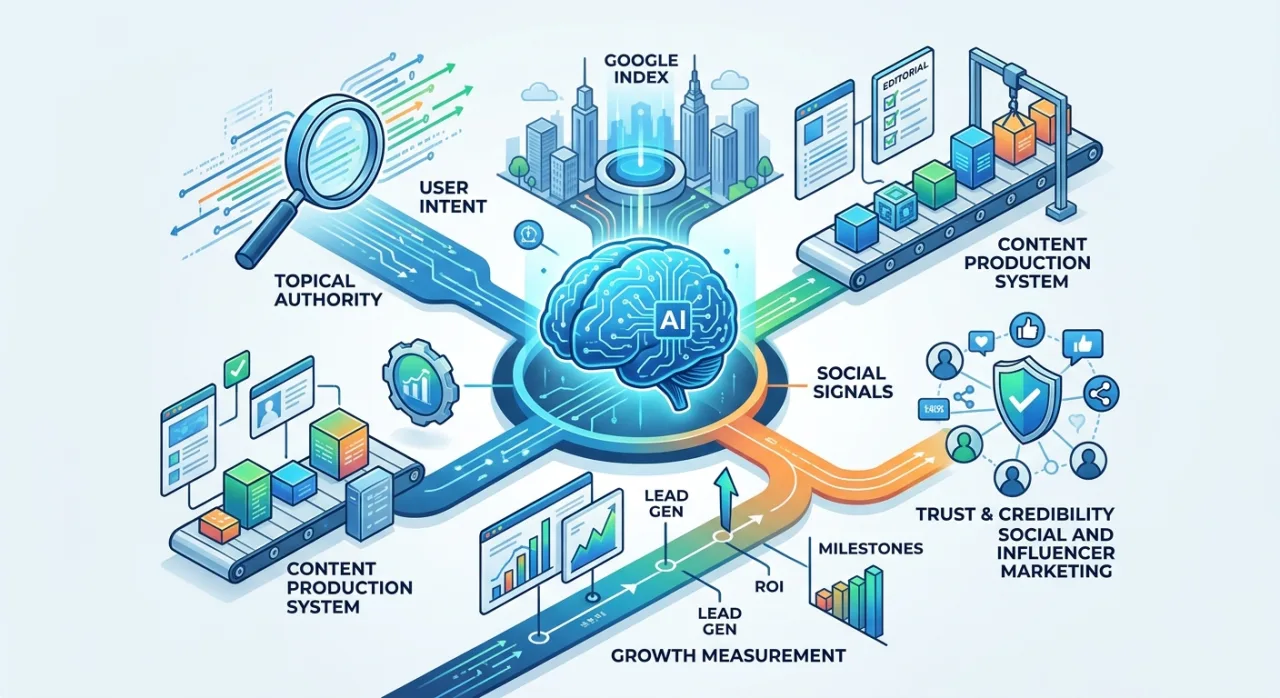
 Search visibility is no longer determined by single-keyword targeting. Today’s buyer journey is highly fragmented: prospects move dynamically between search engines, social platforms, review hubs, short-form video, and AI answer engines before taking action.
To win in this new environment, growth teams must bridge the gap between technical SEO, structured content management, digital PR, and AI-driven workflows. The brands that dominate today build unified digital ecosystems grounded in audience research, strong editorial judgment, and performance analytics.
Why Search Marketing Requires a Strategic Shift
Traditional SEO prioritized ranking individual pages for isolated search phrases. While keyword optimization remains necessary, modern search algorithms evaluate comprehensive topical authority, content context, user intent, and domain expertise.
Before committing to a content calendar, marketing teams must map customer queries, buying friction, and comparative language across every stage of the funnel. For example, a resource covering lead generation must thoroughly address audience segmentation, high-converting landing pages, performance analytics, and automated email nurturing rather than relying on a single isolated tactic.
Essential Principles for Topical Dominance
-
Map Topics to Buyer Intent: Align every asset with specific customer pain points and decision-making stages.
-
Architect Smart Link Structures: Connect core definitions, implementation guides, practical examples, and success stories using contextual internal links.
-
Validate Information: Reinforce every major claim with transparent data, firsthand experience, or verified expert insights.
-
Maintain Content Freshness: Continually refresh legacy assets as user behavior, search interfaces, and industry practices evolve.
Key Takeaway: AI tools accelerate research and outline creation, but strategic vision belongs entirely to human leadership. Machine learning identifies patterns, but humans guarantee accuracy, tone, and brand reputation.
From Creation to Scalable Content Production
Creating content is simply the act of drafting an article, script, or asset. Content production, by contrast, is the end-to-end operational engine that powers scalable growth. It encompasses research, briefing, drafting, editing, asset design, governance, distribution, and continuous performance review.
Without a structured content production system, marketing teams produce assets quickly but struggle with inconsistent brand messaging, duplicated effort, missed deadlines, and unmeasured ROI.
The Content Production Lifecycle Matrix
| Production Stage | Core Objective | Key Deliverable |
| 1. Research | Uncover critical audience insights and data points | Source repository & intent map |
| 2. Planning | Select the optimal content format and distribution channel | Brief, content outline & channel strategy |
| 3. Creation | Articulate ideas with clarity, authority, and engagement | Approved copy, visuals, or video assets |
| 4. Review | Ensure strict factual accuracy, quality, and brand alignment | Polished, editor-approved final asset |
| 5. Measurement | Track and evaluate real-world business impact | Performance report & optimization plan |
Unifying SEO, Social Channels, and Creator Partnerships
Search and social marketing achieve maximum impact when executed together. Social platforms reveal real-time audience questions, emerging trends, and raw user vocabulary. Search engine optimization then converts those immediate signals into long-term, compounding educational resources.
Integrating influencer marketing adds another powerful layer of authentic context. Regional creators and niche industry experts bring deep credibility that traditional advertising cannot match.
Checklist for High-Impact Creator Partnerships
-
Audience Alignment: Confirm that creator demographics directly overlap with your ideal customer profile.
-
Engagement Depth: Analyze comment quality, user discussion, and intent rather than vanity follower metrics.
-
Formal Governance: Document usage rights, content ownership, clear timelines, and FTC disclosure rules in writing.
-
Multi-Channel Repurposing: Adapt high-performing collaborations into long-form search guides, short video clips, FAQ pages, and sales enablement assets.
What B2B Case Studies Reveal About Sustainable Growth
High-converting B2B case studies provide clear visibility into business constraints, strategic interventions, and measurable financial outcomes. A vague success story offers little practical value to sophisticated decision-makers.
In complex B2B sales cycles involving multiple stakeholders, growth strategies rely on connected tactics: digital PR drives high-level domain authority, organic search content educates prospective buyers, and detailed B2B case studies give sales teams the conversion proof required to close enterprise deals.
[ Awareness / PR ] ➔ [ Search Education ] ➔ [ Proof / Case Studies ] ➔ [ Sales Conversion ]
Essential Growth Metrics to Track
-
Qualified Pipeline Leads (MQLs/SQLs)
-
Organic Search Visibility & Share of Voice
-
Account-Based Engagement Across Key Segments
-
Conversion-Assisted Revenue
-
Customer Acquisition Cost (CAC) Reduction
Building a Governed AI Marketing Framework
AI implementation yields the best results when structured as an enterprise-governed workflow rather than ad-hoc prompting. Organizations must establish clear data privacy protocols, brand guidelines, source verification benchmarks, and designated review checkpoints.
Set Business Goals ➔ Select AI Tools ➔ Test Limited Workflow ➔ Measure Against Baseline ➔ Scale Success
-
Define Clear Business Objectives: Target specific operational outcomes, such as decreasing production cycle time or boosting qualified organic sessions.
-
Establish Human Guardrails: Reserve final editorial approvals, strategic positioning, and sensitive communications strictly for human specialists.
-
Benchmark & Iterate: Compare AI-supported output directly against human-led baselines to ensure output quality remains consistently high.
Final Thoughts for Modern Growth Leaders
Digital marketing will continue to shift as search engines, social platforms, and AI engines evolve. Organizations that invest in disciplined production workflows, credible content, and structured measurement frameworks will capture market share while others struggle to keep up. Advanced technology accelerates your speed, but strategic clarity, trust, and exceptional quality drive lasting growth.