
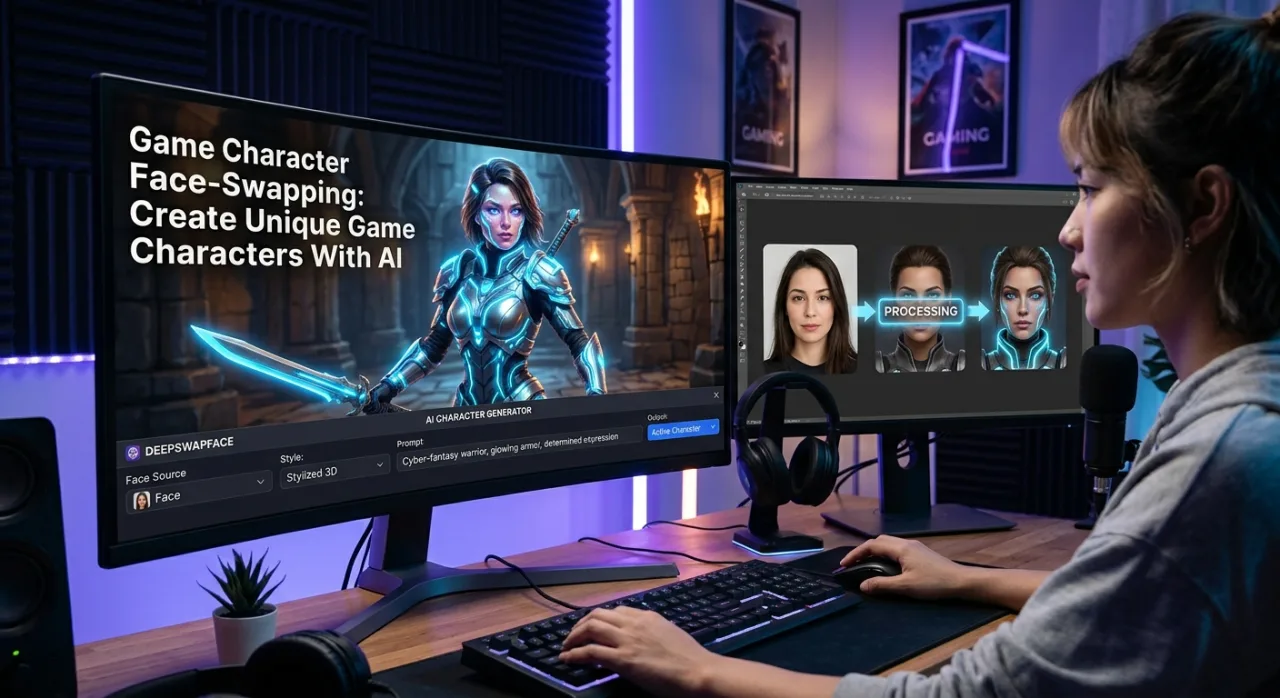
 Game characters are often what make a game memorable. Their faces, outfits, and visual styles define their personalities. Today, modern AI tools make it easier for gamers, fan artists, and content creators to experiment with character designs without starting from scratch.
Game character face-swapping is a primary way to achieve this. Combined with AI character generation, image-to-image editing, and text-to-image tools, it opens up fresh possibilities for gaming artwork, fan edits, and original character concepts.
What Is Game Character Face-Swapping?
Game character face-swapping uses AI to replace a face in an image or video while retaining the core composition of the original piece. Creators use it to build alternative character portraits, funny gaming edits, or customized visuals for social media.
-
Practical Applications: Rework a fantasy RPG screenshot into a custom fan poster or create unique variants of character portraits for gaming thumbnails.
-
Key Factors: The final quality depends heavily on source resolution, lighting, and how clearly the face appears in the frame.
-
Limitations: Face-swapping serves as a visual experimentation tool. It does not replace detailed modeling and animation work required for production-ready game assets.
Create Original Characters With an AI Character Generator
Sometimes, changing an existing character is not enough; you need a completely new hero, villain, or NPC for a game concept. An AI character generator turns text descriptions into visual starting points. Describe a cyberpunk mercenary with neon armor, a fantasy mage with weathered robes, or a futuristic warrior carrying an energy blade, and the tool builds an image matching your vision.
Platforms like DeepSwapFace feature specialized AI Character Generators that help creators explore different character concepts without drawing every detail manually.
| Prompt Component | Focus Elements | Examples |
| Appearance | Hairstyle, facial features, silhouette | Short silver hair, sharp jawline, lean build |
| Outfit | Armor, clothing, accessories | Tactical leather jacket, glowing energy gauntlets |
| Art Style | Visual rendering technique | Anime, realistic fantasy, comic-book art, stylized 3D |
| Setting | Environment backdrop | Medieval fortress, neon-drenched metropolis, alien planet |
A structured prompt gives the AI clear direction, ensuring the output closely matches your design goals.
Use Image-to-Image Tools to Refine Character Designs
If you possess an existing sketch, portrait, or reference image, image-to-image generation lets you explore new iterations without starting from a blank page.
-
Sci-Fi Sketches: Transform rough concepts into polished digital illustrations.
-
Style Shifting: Reimagining a traditional fantasy portrait in a sleek anime style.
-
Consistency: Use clear reference images and specify which elements must remain static to minimize unwanted AI alterations.
Generate Gaming Artwork From Text
Text-to-image tools generate visuals entirely from written descriptions. Beyond character portraits, they create fictional game environments, concept art, item designs, and backgrounds for gaming videos.
-
Fantasy: A ruined castle beneath a stormy sky provides a solid foundation for adventure art.
-
Cyberpunk: A neon-lit city filled with futuristic vehicles fits sci-fi game concepts.
Moving From Static to Animated Content
Static character artwork can serve as a launchpad for animated media. Image-to-image and image-to-video tools introduce movement to still assets, making them ideal for gaming edits, social clips, and concept presentations. However, complex armor or unusual poses can fluctuate across frames, so review generated video files carefully.
Quick Guide: Best Practices for AI Game Character Creation
-
Use Clear References: Blurry images and obscured faces reduce output reliability.
-
Keep Prompts Focused: Describe core visual elements rather than mixing unrelated concepts.
-
Refine Gradually: Adjust one or two parameters at a time to track improvements.
-
Inspect Final Outputs: Scan for distorted facial features, clipping accessories, or unnatural motion.
-
Respect Copyright and Consent: Never misrepresent fan edits as official game artwork or use real likenesses without permission.
Final Thoughts
Game character face-swapping is a practical method for reimagining familiar faces, while AI character generators and image editors turn fresh ideas into polished concepts. By integrating text-to-image and video features into your workflow, you can expand your creative output from static illustrations to fully realized animated presentations with minimal manual overhead.