
The decision to enroll an infant in early childhood care represents a pivotal moment for families. During the first 1,000 days of life, care environments actively shape brain architecture, early language acquisition, and lifelong emotional self-regulation. Modern early childhood frameworks transform the nursery from a space of simple supervision into a dynamic, relationship-based learning setting where every routine holds educational value.
When qualified educators respond promptly and tenderly to an infant’s subtle cues, children learn that their expressions, needs, and feelings are valued.
Understanding Relational Pedagogy and Infant Brain Development
In contemporary early learning, relational pedagogy forms the backbone of effective infant care. During the first two years, a baby’s brain forms over one million new neural connections every second. These neural pathways grow through predictable, secure interactions with primary caregivers.
When infants receive warm, attuned care, their stress hormone levels drop, allowing natural cognitive curiosity to take over.
+-----------------------------------------------------------------------+
|                   INFANT BRAIN DEVELOPMENT ENGINE                     |
+-----------------------------------------------------------------------+
|  Consistent Caregiver Responses  --->  Lowered Cortisol Levels        |
|  Lowered Cortisol Levels         --->  Increased Neural Pathway Growth |
|  Neural Pathway Growth           --->  Confident Environmental Exploration |
+-----------------------------------------------------------------------+
Shift from Transactional to Relational Care
Modern infant programs move away from mechanical routines, using everyday moments to build language skills and emotional bonds:
| Care Aspect | Transactional Caregiving (Outdated) | Relational Pedagogy (Modern Standard) |
| Feeding Routine | Scheduled bottle delivery focused on physical intake alone. | Interactive, quiet conversation maintaining direct eye contact and vocal responsiveness. |
| Diapering | Rapid, mechanical task to meet hygiene standards. | Playful, one-on-one bonding moment utilizing games like peek-a-boo and descriptive language. |
| Staff Allocation | Rotating staff managing large groups interchangeably. | Key Caregiver Approach: Dedicated primary educators responsible for specific infants. |
For parents researching local care options, exploring [high-quality early learning frameworks] to see how primary educator models are implemented provides essential context during facility visits.
Key Attachment Models in Modern Nurseries
Babies make sense of their world through secure attachments. When an infant knows that a whimpering cry, eye rub, or babbling sound triggers an affectionate response, their nervous system stabilizes into a state of security.
Frameworks like Australia’s Early Years Learning Framework (EYLF V2.0) emphasize Belonging, Being and Becoming, reinforcing that emotional confidence must precede cognitive exploration.
Expert Insight:
“Infants learn best when they are surrounded by caring adults who are responsive to their individual signals and flexible in meeting their needs.”
Dr. J. Ronald Lally, Founder of the Program for Infant/Toddler Care
Observing how educators greet infants during morning drop-offs quickly reveals a center’s attachment culture. Dedicated key educators provide a stable anchor during daily home-to-nursery transitions.
Designing Nursery Spaces for Active Sensory Exploration
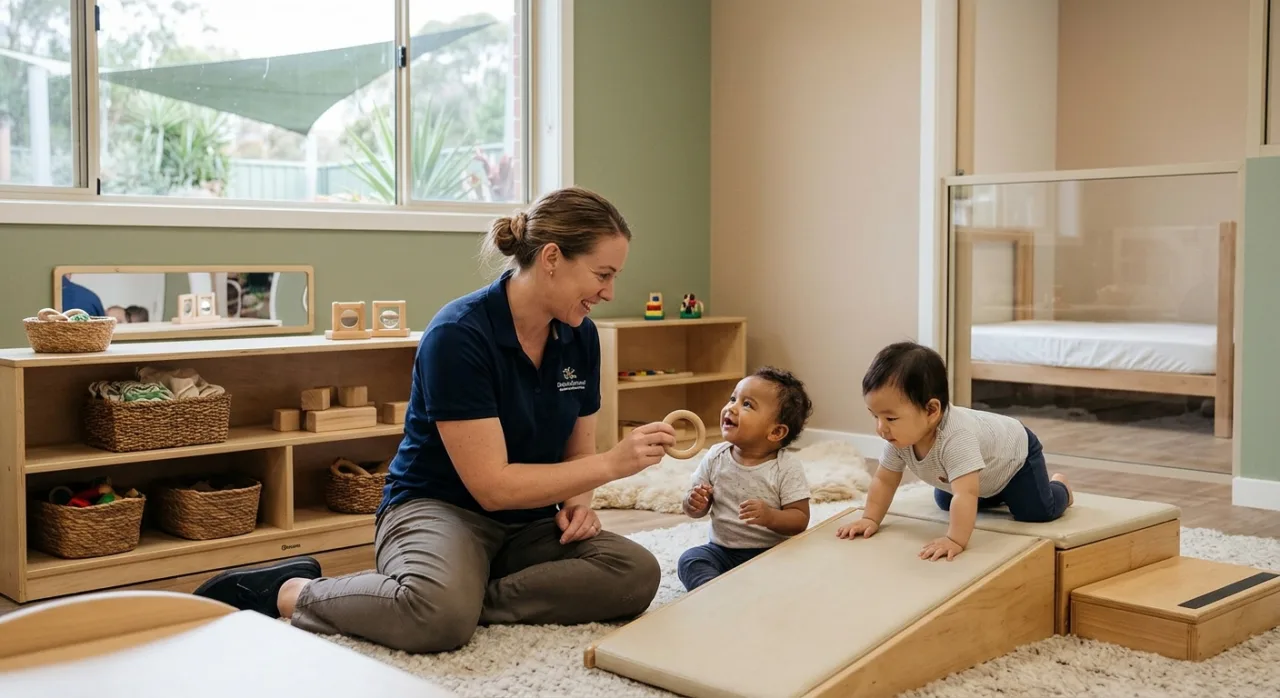
Infants explore their world through tactile, auditory, and visual interaction. A well-constructed nursery balances low-stimulation rest zones with rich exploration spaces crafted from natural materials. Instead of bright plastic toys with artificial sounds, high-performing nurseries prioritize open-ended sensory objects that encourage cause-and-effect learning.
Essential Elements of a Modern Nursery Layout
-
Low-Level Support Risers: Sturdy timber rails and cushioned ramps that help crawling infants pull themselves up safely to master motor milestones.
-
Unstructured Natural Materials: Smooth wood blocks, woven baskets, organic cotton fabrics, and shatterproof mirrors that deliver diverse tactile and visual feedback.
-
Acoustic & Lighting Control: Soft floor rugs, sound-absorbing ceiling panels, and dimmable lighting systems that prevent sensory overload.
-
Direct Outdoor Access: Dedicated infant play yards with soft grass, shade sails, and low sand basins that allow safe interaction with outdoor breezes and natural textures.
Managing Separation Anxiety: A 4-Step Drop-Off Strategy
Separation anxiety is a normal developmental milestone emerging between 6 and 18 months. It demonstrates that an infant has formed a healthy preference for primary caregivers and understands object permanence knowing parents still exist even when out of sight.
       [ Morning Arrival ]
               │
               ▼
   [ 1. Execute Goodbye Ritual ]  <-- Keep it brief & identical daily
               │
               ▼
   [ 2. Direct Hand-Off ]         <-- Hand baby directly to Key Educator
               │
               ▼
   [ 3. State Explicit Return ]   <-- "I will return after afternoon tea!"
               │
               ▼
   [ 4. Confident Exit ]          <-- Avoid lingering at the doorway
To streamline morning routines, early childhood specialists recommend four concrete steps:
-
Establish a Short, Repeatable Goodbye Ritual: Keep the sequence identical every day (e.g., two hugs, a gentle nose boop, and handing the baby directly to their educator).
-
Avoid Lingering at the Doorway: Hesitation communicates uncertainty to the child. Give a warm goodbye, complete the hand-off, and exit confidently.
-
Never Sneak Away Unannounced: Leaving while a child is distracted breaks trust, making the infant hyper-vigilant during future drop-offs. Always state clearly that you are leaving and will return.
-
Provide Immediate Morning Updates: Share rapid updates at the door such as night sleep quality, feeding times, or teething discomfort so educators adapt care plans instantly.
Evaluating Nursery Programs: Center Inspection Checklist
When evaluating potential providers, look past marketing brochures and observe daily operational standards directly against this checklist:
[ ] Educator Ratios      -> Strict 1:4 (or better) educator-to-infant ratio maintained.
[ ] Staff Stability      -> Low staff turnover in infant rooms; primary care model present.
[ ] Flexible Sleep Schedules -> Naps aligned with home routines rather than forced room-wide windows.
[ ] Safe Sleep Protocols -> Cot rooms feature firm mattresses, clear cots, and constant monitoring.
[ ] Meal Progression     -> Tailored transitions from breastmilk/formula to solids and allergen introductions.
[ ] Real-Time Updates    -> Daily digital or verbal updates covering feeding, sleep, and developmental milestones.
When an early learning center aligns responsive educators, intentional physical design, and active family communication, infants gain the emotional security required to explore, develop, and thrive. For additional guidance on nursery selection criteria, refer to our comprehensive [childcare center evaluation guide].