Selecting a humanoid robot often begins with a clear testing of what the system can physically do, how intelligently it can perceive and act, and what it will cost to operate over time. A good buying decision actually matters more than appearance or demo videos. You have to test its mobility, joint design, stability, payload, manipulation capability, software openness, and safety systems.
Research Service Interaction or Performance Applications These Details
For research, service, interaction, or performance applications, these details directly affect deployment success. The right humanoid should match your real tasks, support future development, and stay reliable in day-to-day use instead of only performing well in controlled demonstrations or marketing showcases.
Check physical performance and hardware capabilities before anything else.
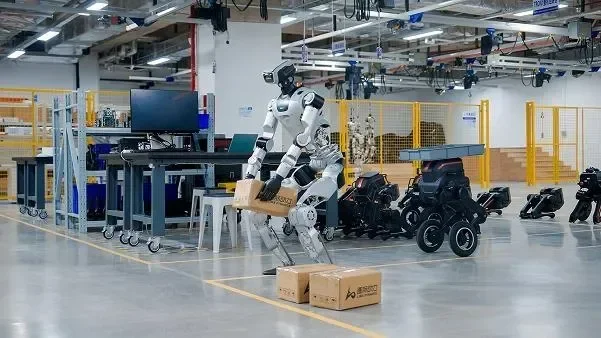
Begin by checking how naturally and reliably the humanoid moves. Mobility is not just about walking speed; it includes balance recovery, posture transitions, turning, terrain management, and stability during interaction. Degrees of freedom are important because they determine how closely the robot can reproduce human-like motion. LimX Oli is a full-size humanoid robot at 165 cm tall with up to 31 DoF, giving it a wider range of postures and movement options for research and service scenarios. Its self-developed 6-axis IMU is designed for stronger anti-interference performance and minimized drift, which supports steadier motion control. Also assess whether the robot can function and transport easily, since practical deployment usually matters as much as raw movement capability.
A humanoid may walk well but still fail at helpful work if its arms, hands, or tool interfaces are limited. Check the payload each arm can manage, the precision of hand and wrist movement, and whether the robot supports different end-effectors for grasping, carrying, pressing, or specialized task execution. Dexterity matters for close-range manipulation, not just easy pick-and-place motions. Review joint responsiveness, repeatability, and control smoothness when interacting with people or objects. You should also confirm whether hardware and electrical interfaces allow future upgrades as application requirements change. A flexible manipulation platform is more important than a robot that performs one scripted action well but struggles with varied, real operational tasks.
It Is Important to Assess AI Capability
It is important to assess AI capability and development flexibility.
AI capability should be evaluated by how well the humanoid senses its environment, processes data, and acts without constant human intervention. Review onboard computing architecture, sensor placement, and support for autonomy in navigation, manipulation, and interaction. LimX Oli uses independent compute for motion control and perception, which offers developers a stronger platform for advanced algorithm research. It includes a head-mounted Intel RealSense D435i for wider environment perception and autonomous navigation, plus a chest-mounted D435i for close-range manipulation, human-robot interaction, and obstacle avoidance. With support for external sensors, for example, LiDAR and extra cameras, the system can be expanded for more demanding workflows in complex environments and dynamic application settings.
A humanoid becomes far more helpful when your team can build on it without fighting closed tools or limited documentation. Check whether the robot provides accessible APIs, software development kits, electrical interfaces, and support for custom models, workflows, or knowledge bases. LimX Oli offers USB interfaces supporting 3.0 and 3.2 protocols, helping simplify external device integration. It also supports a self-developed voice interaction system with bilingual Chinese and English conversation and voice control, while custom knowledge bases can be uploaded for particular scenarios. For rapid content creation, Studio software enables intuitive no-code choreography, and the dance library supports OTA updates. This combination is important for teams balancing research flexibility, interaction design, and deployment speed.